Beyond the Surface: Fascinating Facts About Hierapolis
Key Data & Statistics
Numbers that reveal the scale and significance of this ancient wonder.
Total Area
Combined UNESCO site area
Peak Population
During Roman era
Spring Temperature
Natural thermal water
Elevation
Above sea level
Years of History
Founded c. 190 BCE
Necropolis Tombs
One of the largest in antiquity
Fascinating Facts You Should Know
Discover the intriguing stories and lesser-known details about Hierapolis.
The name 'Hierapolis' comes from the Greek words 'hieros' (sacred/holy) and 'polis' (city). However, some scholars believe it may have been named after Hiera, the legendary Amazon queen and wife of the mythical founder Telephus.
The Plutonium (Pluto's Gate) at Hierapolis was considered an entrance to the underworld. Ancient writers like Strabo described how the toxic carbon dioxide gases killed small animals, while priests seemingly demonstrated immunity to the fumes - a mystery only recently explained by scientists.
Hierapolis was the ancient equivalent of a modern spa resort. Wealthy Romans would travel hundreds of miles to soak in the mineral-rich thermal waters, believing they could cure ailments from rheumatism to heart disease.
With over 1,200 tombs spanning nearly 2 kilometers, the Hierapolis Necropolis is one of the best-preserved and largest ancient cemeteries in the world. The tombs represent various styles from sarcophagi to tumuli.
Hierapolis was famous for producing vibrant purple-dyed textiles. The calcium-rich thermal waters were perfect for fixing dyes, and the city became a major center of the textile industry. The term 'turkey red' may have origins in this region.
Hierapolis is mentioned in the Bible in Colossians 4:13, where Paul commends Epaphras for his work in the churches of Laodicea, Hierapolis, and Colossae. This trio of cities formed an important early Christian community in the Lycus Valley.
Notable Structures & Their Dimensions
Measurements that showcase the grandeur of Hierapolis.
| Structure | Measurements |
|---|---|
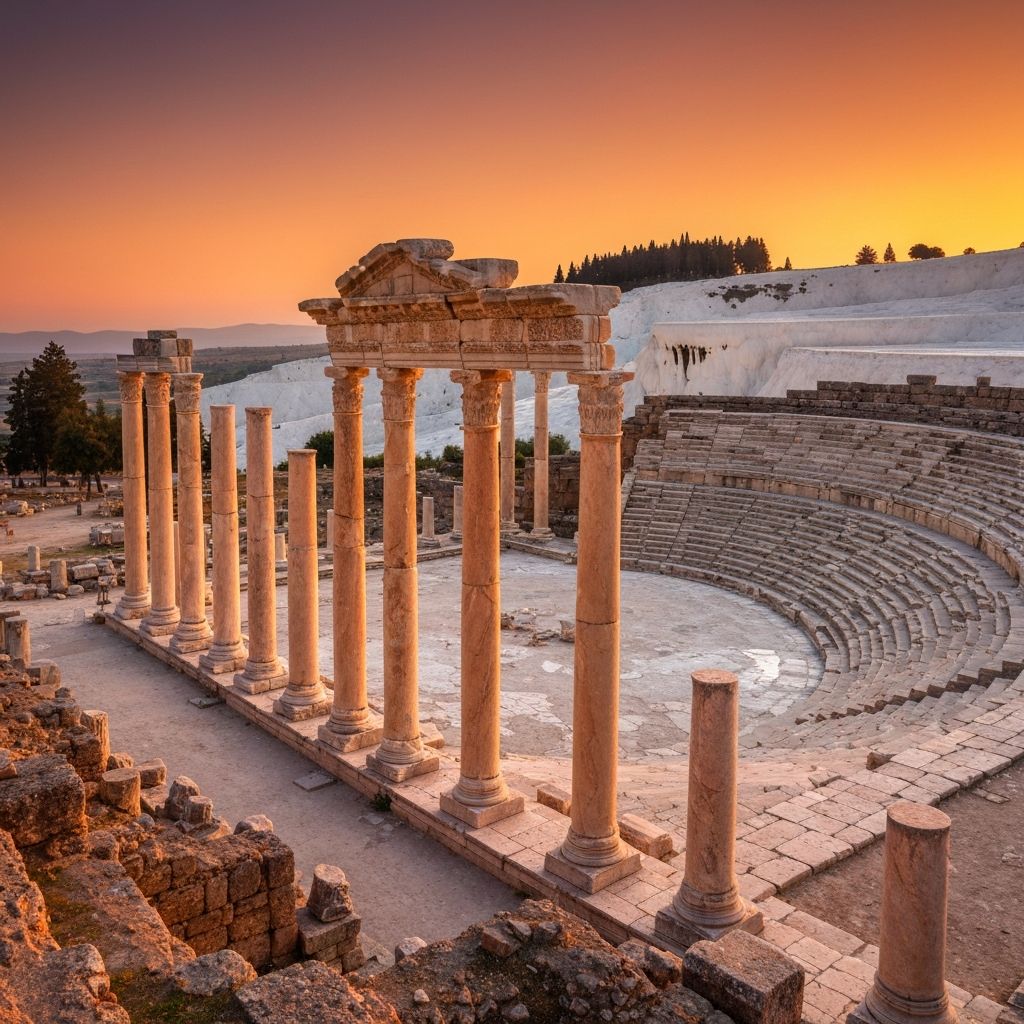
| Ancient Theater | Cavea diameter: 100m, Height: 50m, Capacity: 15,000 |
| Main Colonnaded Street | Length: 1 km, Width: 13.5m |
| Necropolis | Length: 2 km, Tombs: 1,200+ |
| City Walls | Length: 2 km (partially preserved) |
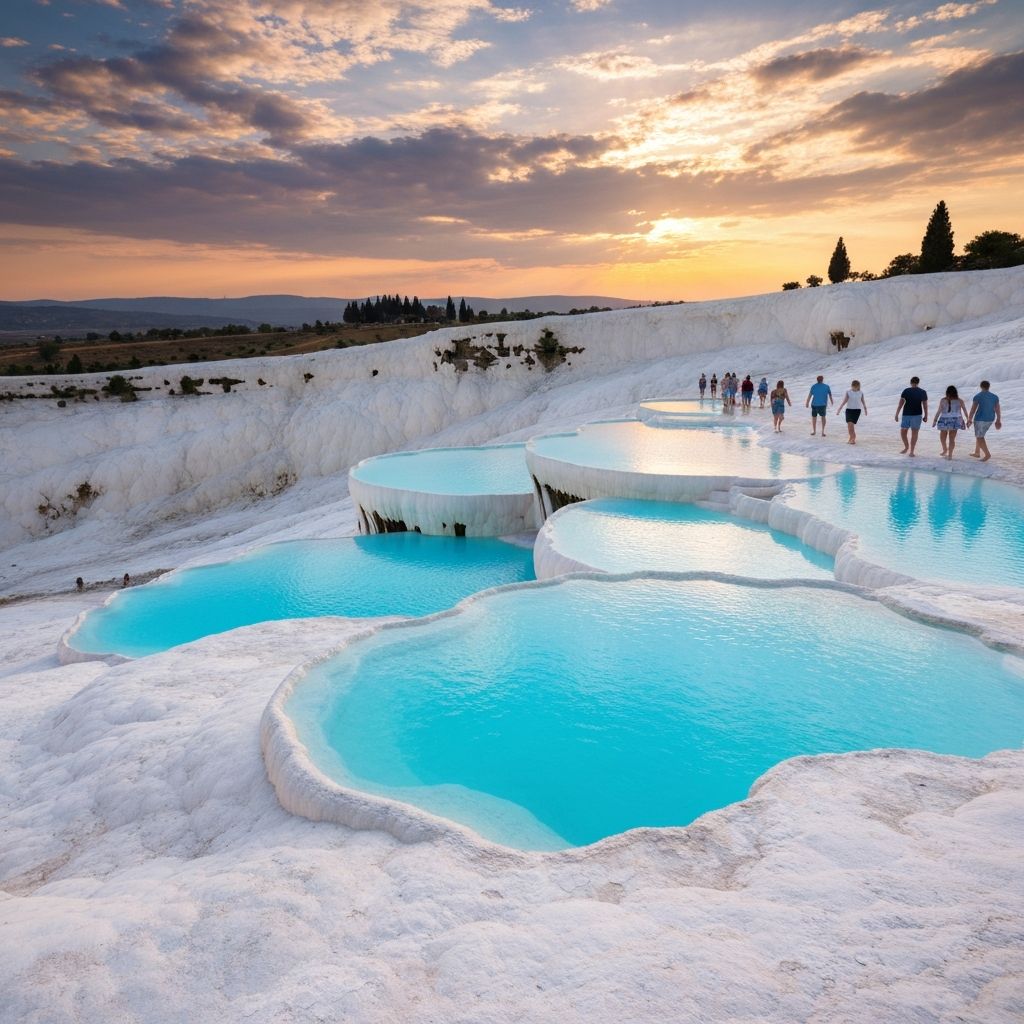
| Travertine Terraces | Length: 2.7 km, Width: 600m, Height: 160m |
Holy City or City of Brass?
The etymology of Hierapolis has been debated by scholars for centuries. The most accepted interpretation is that it derives from the Greek "Hieros" (sacred/holy) and "Polis" (city), giving us "Holy City" - a fitting name given the numerous temples and the sacred thermal springs.
However, an alternative theory suggests the city was named after Hiera, a legendary Amazon queen in Greek mythology. According to this version, Hiera was the wife of Telephus, the mythical founder of Pergamon and son of Hercules.
Some historians have also connected the name to the Semitic word for "brass" due to the region's metalworking traditions, though this interpretation is less widely accepted today.
Hierapolis in Different Contexts
Hierapolis holds special significance in Christian history. The city is mentioned in the New Testament in Paul's letter to the Colossians (4:13): "I vouch for him that he is working hard for you and for those at Laodicea and Hierapolis."
The city became an important early Christian center, with tradition holding that the Apostle Philip was martyred here around 80 CE. His tomb was discovered by Italian archaeologists in 2011, confirming centuries of religious tradition.
During the Byzantine period, Hierapolis served as an important bishopric, and the magnificent Martyrium of St. Philip became a major pilgrimage destination for Christians throughout the Mediterranean world.
Hierapolis represents the remarkable synthesis of Hellenistic, Roman, and early Christian cultures. The city's architecture, art, and religious practices reflect the diverse influences that shaped this corner of ancient Anatolia.
The unique combination of natural thermal waters, sophisticated urban planning, and religious significance made Hierapolis a model of ancient city development - lessons that continue to inform archaeological and historical research today.